About julie@goforchange.com

Julie Gabrielli is fascinated by the power of story to heal, reconnect, and create our world. She has logged years of dedicated studentship and mentorship through work as an architect. She also uses writing, painting and film to explore the threshold between damaging cultural stories and emerging new narratives. Her Restorying retreats offer a place to listen for and experience our inherent belonging and connectedness. Parenting used to be her most humbling activity until she started writing a novel.

Keeping good company

Breaking Through_adjusted

I’ve committed to exploring and living in this threshold between stories, this liminal time of both/and, not because I believe it’s Right and anyone who doesn’t get it or come along with me, or who cannot relate to this perspective, is Wrong. Or that this is The Answer, or The Solution to all our problems. I just love the people I’m meeting, who challenge and inspire me. I enjoy being with them. They are good company.

About fifteen years ago, my partner and I had a thriving green architecture firm. Hip deep in LEED consulting, small design projects, sustainability initiatives, lecturing and teaching, we were helping to put Baltimore on the map of community sustainability and eco-mindedness. I had always been a very focused architect, completely dedicated to my profession and craft. So much so, looking back, that I was oblivious to the real reasons we do this work. I thought it was to be the best, to make beautiful (if not perfect), technically excellent buildings. To dive in deep, control all the variables and requirements, and create an innovative project that not only solved all of the client’s problems, but also a few more we threw in just to keep it interesting. Continue reading
Improvisation unlocks the magic of spontaneity and connection

2006_Maine_620w

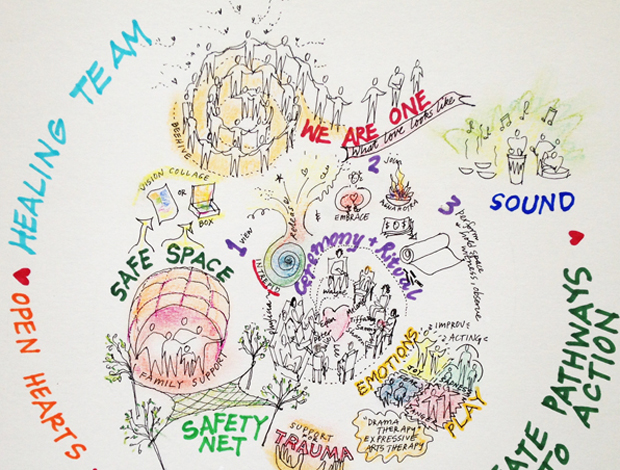
All told, we’ve collaborated to offer eleven Restorying retreats over the last two years, with more in the planning stages. They’ve come to have a dynamic balance between structure and improvisation. We are learning as leaders to be present and notice the field, to give ourselves over to what wants to happen next, what the earth is dreaming for us. Within a framework of ritual and ceremony, poetry and mythic time and space, we enter the door that leads to the realm of heart and soul and mystery.

Themes, questions, and insights begin to weave into and through the assembled group from the first gathering. We are getting better at tuning into that and inviting participants to join in the fun of giving ourselves over to what Mystery wants to do with us. It reminds me of what Malcolm Gladwell had to say about improvisation in his book, Blink. Using basketball as an example, he wrote that in practice, the players drill patterns and set-ups relentlessly, and then every game is totally improvisational. The patterns are strung together in completely new ways in every game, every moment. I can guess from the way my son talks about soccer that it’s much the same. Continue reading

Who are we at war with? Let’s be honest about opposites.

2014_6.29_620w

I usually refrain from engaging in arguments on political or economic theory because I don’t consider myself to be well enough informed to do any particular stance justice with supporting evidence. Today I learned that my reasons go deeper than that. I recently violated my own injunction by posting a quote from Governor Scott Walker on my Facebook page about dependence on the government. He was calling up a trope from the Reagan era, one that ignores that he and all Americans are dependent on the government for roads, help in emergencies, and education, to name only a few.

In the ensuing back and forth argument, my Libertarian cousin chimed in about the role of government, taxation, military spending, energy policy, and the squeeze of the middle class. I responded that it saddens me to see finger pointing at “those people” who are on public assistance. Maybe if their place of work (WalMart, McDonald’s) paid them a living wage, they could afford to put a roof over their head and food on the table without such help. Or if the “education” they received had actually educated them, they could get a higher paying job. It’s so small minded and petty, and reflects poorly on Americans. I still prefer to believe that we are capable of much better. And yet my salvo is a distraction from the deeper lessons of this exchange. Continue reading

Jumping out of a moving car is ill-advised, but I did it anyway

1987_8.1_Piazza-Armerina_620w

I am not by nature a patient person. Back when I was working with organizations to design and launch sustainability initiatives, we had a metaphor that I liked very much. I borrowed it from one of the early thought leaders of green architecture, William McDonough. He was fond of pointing out that a fundamental problem with sustainable design as defined and implemented is that so much of it was about “being less bad.” He would say, if you’re driving to Canada at 70 miles an hour and you realize you really need to be going to Mexico, you won’t get there by driving to Canada more slowly. You have to turn the car around.

I’m all about turning the car around. Why use all this energy when technology and craft exist to cut our energy use in buildings by 70% right now, today? Yet, clients seemed always to be dragging their feet, even in the face of overwhelming evidence. One day, when I was voicing my frustration with how long all this change stuff was taking, my colleague accused me of wanting to bail out of the car altogether, while it’s still going 50 mph. And he was right! Continue reading

What we are doing in this time between stories

3.26.15_Meeting_topI’ve been participating in a fascinating online course convened by Charles Eisenstein called the Space Between Stories. There is an active forum as part of the course and I’ve been able to join in a few conversations with people from all over the world. One of the topics that’s captured my imagination is our longing for clarity about what to do, once we’ve recognized that the dominant cultural stories, that we were raised on and that constantly surround us, are mistaken and damaging. Once we see that, we cannot unsee it, and can go with the program only at great cost to our sanity and health. Which opens up a rather intimidating question: now what?

Paul Kingsnorth of the Dark Mountain Project, has a humble and inspiring list of five actions at the end of his beautiful essay, “Dark Ecology.” While I can wholeheartedly agree with his assessment, I am also aware that part of living into New Stories is that each of us must find our own way. Not in isolation, surely, but in recognition that our paths are as unique as we are. It’s such a different way of thinking that I’m constantly having to remind myself that’s it’s really okay not to know. Not to know where I’m headed or what will happen along the way, not to know if climate change will get the better of us in my lifetime or my son’s, not to know whether this awareness is going to destroy precious friendships and relationships or whether “enough” people will come to this same awareness to make a difference in all the environmental, social, and economic collapse going on around us. Not to know much at all. Continue reading

On clearing, patience, trust, and magic

2009_8.26_Yosemite2_620w-3I love the image from Martha Postlethwaite’s poem of clearing a space. It’s a beautiful reminder to tend to my inner landscape, before I turn to outward work, no matter how urgent or grandiose the calling feels. The recommended order is: go inside, open your hands and wait for your song to drop into them.

Which implies two important points. One, that we each do have a song. And, two: that all we have to do to receive it is make a small clearing in our dense, wild places and wait patiently. Just ask and it will come. That it will fall into my open cupped hands is a nice image. It implies a readiness just this side of expectation, a proper, welcoming stance. Receptivity sourced from trust. Continue reading

The constant invitation of the eternal

2012_9.8_620w

It is in dying that we are born to eternal life.

There is a literal way of seeing this that comes out of my Catholic upbringing. How fitting that I should finally be considering this final verse of St. Francis’ prayer on Easter weekend. The literal story is that Christ came to live among us as a man. “God so loved the world that he gave his only begotten Son. . . .” So the verse goes. I was taught that Christ gave his life so that humans may have eternal life—in a place called Heaven.

It requires a certain effort to pan out to see a bigger picture. The story can be a lens through which to view an individual life (mine), in the context of a culture and, beyond that, ecosystems and planet and universe. And, zooming in the other direction, inspired by the great short film, “Powers of Ten” by Charles and Ray Eames, to see what goes on beneath the surface of my skin, in those interior realms of thought and belief and intuition, and deeper still to shadow and unconscious, into the place before thought and individuality. Continue reading

The empty echo chamber of jury duty

1987_8.2._Agrigento-Temple-of-Hercules_620wOne of the ways I test my relationship with old and new stories is by comparing my reactions to current experiences versus where I was “before.” I used to love Jury Duty. The vaunted process of being tried and judged by one’s “peers,” having come down to us over centuries, is the very pinnacle of civilized society. Or so the old story goes.

My first jury service as a citizen of Baltimore was for a murder in a barbershop. The trial lasted five days, during which my life was turned upside down. Since I was teaching architecture studio at university, I had to ask colleagues, and even my husband, to substitute for me. Cancelling is not an option with design studio. Yet the whole thing fascinated me: the unconvincing young prosecutor on what might have been her first case, the public defender who had seen it all, the diverse members of the jury who resisted having to send away yet another lost boy, and the quirky judge whom I later learned was good friends with John Waters and had ceramic skulls decorating her chambers. I also later learned that the murdered barber had been the neighborhood fence for stolen goods, and had cheated the wrong guy. Continue reading

Pardoning helps us experience interconnection

Healing-Team_620w

It is in pardoning that we are pardoned.

Under the influence of the Judeo-Christian values of modern culture, I have the habit of believing the story that we are all flawed, that part of my task in this life is to work on myself, to fix my failings, and try to be less bad. While it’s certainly rewarding to grow and learn and increase my awareness and equanimity, there is a big difference when I come at it with the intent of discovering innate capacities, rather than purging unwanted ones, or rooting out evil and unworthiness.

Forgiveness and blame are two sides of the coin of pardon. When I forgive another, I forgive myself, because pardoning comes from a sense of worthiness—my own and another’s. We are all worthy of empathy and understanding, and therefore pardon. Blame is the opposite of pardon. Blame directs anger outward, making an object out of a subject, creating separation and “othering.” Through empathy and compassion, pardon draws both subject and object together through a shared understanding that we are all connected. Continue reading

Giving and receiving bind us to each other

2.14.15_still life_620w

For it is in giving that we receive

This phrase is familiar to most of us. The joy of giving is greater than the pleasure of receiving. Yet giving carries risk and requires courage. Whatever we are giving may indeed be ignored or refused. If it’s something sourced from deep inside, an intimate, heartfelt gift, refusal can be devastating, even shaming. Giving makes us vulnerable. It’s no wonder that many of us hold in our generosity, especially if we have been burned in the past.

St. Francis doesn’t specify what we receive when we give, only that we receive. We may at times receive a harsh lesson in humility or in the importance of detaching from outcomes. I have been known to give with a certain expectation of how the recipient would react, only to be crushed by their indifference or dislike. The lesson is not to refrain from giving. If anything, it is that giving without expectation is like the graduate school course in generosity. It’s not for the recipient’s reaction that we give; it’s to experience reciprocity. Continue reading