About julie@goforchange.com

Julie Gabrielli is fascinated by the power of story to heal, reconnect, and create our world. She has logged years of dedicated studentship and mentorship through work as an architect. She also uses writing, painting and film to explore the threshold between damaging cultural stories and emerging new narratives. Her Restorying retreats offer a place to listen for and experience our inherent belonging and connectedness. Parenting used to be her most humbling activity until she started writing a novel.

Our voices, our power: women’s paradigm-shifting work

Utensils_620w

“For the master’s tools will never dismantle the master’s house. They may allow us to temporarily beat him at his own game, but they will never enable us to bring about genuine change. Racism and homophobia are real conditions of all our lives in this place and time. I urge each one of us here to reach down into that deep place of knowledge inside herself and touch that terror and loathing of any difference that lives here. See whose face it wears. Then the personal as the political can begin to illuminate all our choices.” ~ Audre Lorde, 1984

The resonance of our inner callings with needs and trends in the outer world seems to be gathering momentum lately. In this time between stories, I am being urged, by both interior and exterior promptings, to value my unique voice and speak up more. The signs I get range from encouragement like Audre Lorde’s 1984 speech, to learning from Priscilla Ward’s eye-opening essay about her experience as a black woman, to the fierce witnessing of Nell Bernstein in this interview about her book on juvenile incarceration, Burning Down the House.

At the time of Audre Lorde’s speech, I was just graduating from college, looking to work a year in a firm before grad school. Very much playing the game by the rules. Ronald Reagan as President was busy dismantling the social safety net so carefully woven over the last decades. The Soviet Bloc countries boycotted the summer Olympics in Los Angeles. Feminism had been around for a couple of decades. Though I did not identify as a feminist, I was entering a traditionally male profession, slipping noiselessly if unconsciously through the access hard-won by my sisters before me. Continue reading
Hiding when out of sync is a generous act of love

1991_Dennis-beach_620w

When I am unconsciously following the rules and stories installed in me during childhood, I sometimes worry that I am doing my life wrong. For instance, I was never taught that there are times when it’s perfectly justified to follow my instincts, to do or be what my heart urges. In fact, a life well-lived is a life entirely guided by the heart’s urgings. Still, I can feel a bit guilty when I need to withdraw from the world’s demands on me.

For so long, I believed that my retreat from conflict, difficulty, boredom, hostility, shame or blame was a bad thing that I inflicted, selfishly, on my close relationships. In this beautiful essay on hiding, the poet David Whyte sees it as a form of self-preservation, a drawing inward to prepare for transformation, and a necessary storing up of vital energy for growth.

“Hiding is one of the brilliant and virtuoso practices of almost every part of the natural world. . .”

Continue reading

Mirroring the courage to speak up and tell new stories

1998_7.12

I’ve long been fascinated by the ways that my inner and outer worlds mirror each other. Even way back in college, I somehow knew that annoying people are reflecting something in me that I don’t like. I’m devoted to dream work and my morning journaling for the insights and clarity that often come, and to writing in this blog for the same reason. I tend to regard this reciprocal conversation as a way to diagnose what’s wrong from the inside out, more so than to notice and appreciate what’s right outside, and how it reflects goodness on the inside.

Yet it does work both ways, and it’s going on all the time. When someone I respect questions or refuses to encourage my latest grand scheme, that is showing me the degree to which I am not on board with it myself. But it’s also true that if I look around at my comfortable home, good health, lovely neighbors, engaging work, responsible husband, and yummy food in the fridge—all that is reflecting an inner world that is safe, healthy, and full of good companionship, worthiness, love, creativity, intelligence, security, and nourishment. Continue reading

We need stories to guide us, especially in an emergency

2000_6.11_Bay-Bridge_620w

“It’s not easy to be patient in an emergency.” ~ Wendell Berry

What is this hold our cultural stories have over us? Even when many of us know the dominant narratives are misguided, damaging, even destructive, we cling to loyalty and feel a terrible sluggishness to act. Like those dreams where something horrible is about to happen and your feet are glued to the ground, or you can’t move your limbs, or have no voice to scream.

Stories exert a powerful magic. Shawn Coyne’s new book, “The Story Grid,” talks about the classic form of the quest story, also called the hero’s journey. It’s an integral part of our humanity, with us since at least the Greeks. Coyne observes that stories give us guidance, models to follow in times of change, and help us temper our anxieties about the unknown. He illustrates with this observation from the book, “The Examined Life,” by psychoanalyst Stephen Grosz: Continue reading

On knowing, despair, unknowing, joy and the wisdom of the body

1999_2.27_Boats_620w

Let me keep my distance, always, from those
who think they have the answers.

Let me keep company always with those who say
“Look!” and laugh in astonishment,
and bow their heads.

~ Mary Oliver, from “Mysteries, Yes

I am a recovering expert. For many years, I was paid to have answers: to advise clients on the best approach for their project; integrate the work of structural, mechanical and civil engineers; and design details that keep the weather out while looking great, costing little and lasting years with no maintenance. In short, I had to know how to juggle a staggering number of variables, get along with others, and tolerate a high potential for disappointment or even failure. It was stressful.

During his recent online course, “The Space Between Stories,” Charles Eisenstein made the observation that thinking you know anything is a prerequisite for despair. He illustrated with a recognizable litany of things we know: We know the world is doomed because of climate change, species extinction, human trafficking, genocide. We also know how things work and what’s possible, so we know it’s not possible to fix any of this. We’ve tried. Consequently, we know we’re doomed. Continue reading

Momentum: an ode to Baltimore

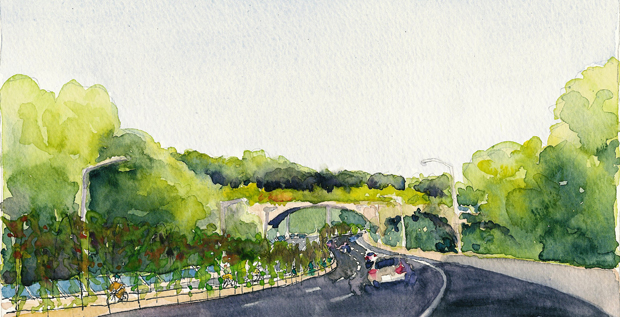
JFX_greenbridge_horiz_620w

I see a Baltimore who mines her gold
from the shadows behind abandoned houses.
I see a city of parks
with tree roots reaching deep beneath surfaces
tapping hidden sources
and joining the disconnected
with living bonds
visible even to eyes grown weary of witnessing.

I see neighborhoods of parades
of dancing and singing
lighting sacred fires
standing arm in arm in solidarity
kneeling down on cracked pavement to pray
to ask blessings and invoke peace
to appeal to the wisdom of the ancestors
the vision of the young. Continue reading

This threshold of despair, fear, anger, and pain could be an opening to a new conversation

Faces

“I believe that all suffering is caused by ignorance. People inflict pain on others in the selfish pursuit of their happiness or satisfaction. Yet true happiness comes from a sense of brotherhood and sisterhood. We need to cultivate a universal responsibility for one another and the planet we share.” ~ Dalai Lama

I am breaking tradition and using a photograph to start this post because it is such a beautiful, heartbreaking image of the pain and fear that keep us separated. There are only a few inches between the faces of these two men, yet it is a wholly unbridgeable gulf. This is a scene from the streets of Baltimore yesterday, a place of constant tension, trauma and hatred, from which those of us living our quiet, privileged lives in other neighborhoods are usually insulated.

Truth be told, I am still insulated, tracking these events, unfolding mere miles away, via social and traditional media. It’s been fascinating to see how people react when our old cultural stories are so blatantly exposed and people act out and behave in ways that shock us. Many are expressing righteous outrage, as when our mayor called the instigators “thugs,” and questioned their intelligence with this comment: “It is idiotic to think that by destroying your city you’re going to make life better for anybody.” Continue reading

The essential questions at the heart of our lives

Still-Life_620wLately, I keep bumping up against that old saw, The older I get, the less I know. I have more questions than answers, and while it is an invitation to humility and surrender, I find myself getting frustrated too. Looking for signs and affirmations that I am on the right track. And suspecting that the signs are everywhere, if only I would notice them. Sometimes I think maybe the questions themselves are the sign.

I recently heard Ricardo Semler speaking on NPR’s TED Radio Hour. In 1980, he took over his father’s company, Semco, and redesigned it to be a corporate democracy, where people design their own jobs, define pay levels, and select and evaluate their supervisors. During his 2014 TED talk, Semler recounts his discovery of the power of asking “Three whys in a row” to access deeper wisdom. Continue reading

What the river says

2012_9.8_620w

. . . We know
the current is there, hidden; and there
are comings and goings from miles away
that hold the stillness exactly before us.
What the river says, that is what I say.
~ William Stafford, from “Ask Me

When I go out into a forest with awareness of my senses, I find myself being called by one of the Others who dwell there. A hawk may circle overhead. A spring wildflower may signal its curiosity. A stately poplar tree may entice me with its craggy bark. Whatever encounters I have will leave me with a sense of wonder, marveling at the intricacy of this tiny part of the animate world. At its unique perfection, a beauty that extends far beyond physical qualities. It is an invitation to the peace of belonging.

A marvelous thing happens when I compare what I have heard in wild places with what others hear. When we gather for Restorying retreats and send people out on the land, they return with movingly personal stories that are also messages to all of us, individually and collectively. It is not unlike working dreams with a few friends. Even though the dream may seem at first to be meant only for me, after some consideration its universal themes begin to emerge. There is the distinct feeling that the dream was sent through me to benefit others, as well as myself. Continue reading

While we are making plans, the Earth is making us

2003_flowers_620w

All I want is to sing to you
The song that no one has heard
~ Krishna Das, from Heart as Wide as the World

We seem to be fond of comparing ourselves to animals, or, as native people tend to call them, the four-leggeds. Our post-Enlightenment minds play this game by finding ourselves to be superior to those “Others.” One story we like is that we are the only conscious beings on the planet, which is rapidly being debunked even by modern science. I did recently think of this difference, though: we make plans. We take on long-term projects that last beyond seasons, that may take five or ten years to complete. And sometimes our projects fail.

Plants and animals are seasonal, and their physical aims much simpler: survival and reproduction. They don’t seem to have the ambition to change their surroundings or invent things or look at distant galaxies, let alone travel to them. They don’t make musical instruments or write symphonies or Shakespearean plays. And yet they are part of a vast dance, a swirling ongoing Creation that is impossible to comprehend in its entirety. While we make plans, the Earth makes us. Continue reading