Pardoning helps us experience interconnection

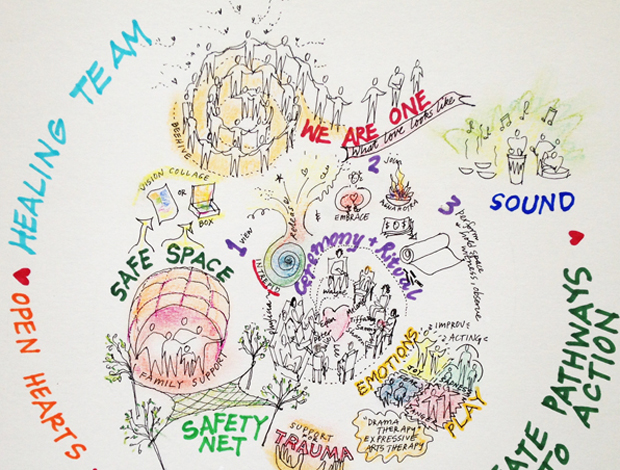
Healing-Team_620w

It is in pardoning that we are pardoned.

Under the influence of the Judeo-Christian values of modern culture, I have the habit of believing the story that we are all flawed, that part of my task in this life is to work on myself, to fix my failings, and try to be less bad. While it’s certainly rewarding to grow and learn and increase my awareness and equanimity, there is a big difference when I come at it with the intent of discovering innate capacities, rather than purging unwanted ones, or rooting out evil and unworthiness.

Forgiveness and blame are two sides of the coin of pardon. When I forgive another, I forgive myself, because pardoning comes from a sense of worthiness—my own and another’s. We are all worthy of empathy and understanding, and therefore pardon. Blame is the opposite of pardon. Blame directs anger outward, making an object out of a subject, creating separation and “othering.” Through empathy and compassion, pardon draws both subject and object together through a shared understanding that we are all connected. Continue reading
From oxygen masks to understanding: naming the emotion is key to empathy

2009_8.26_Yosemite2_620w-3

To be understood as to understand,

The need to be understood has been a lifelong struggle for me. I suspect I am not alone in this, but admit to having very little perspective, as immersed in that longing as I’ve been. The problem is, during an encounter or argument with a loved one, to keep insisting on being understood closes me off from their needs and leads to repetition and stridency.

It strikes me that one of St. Francis’ overarching messages is that we always have the choice between turning inward and reaching outward, between isolation and connection. Between victimhood and generosity. It’s no accident that connection feels better. That being true, I wonder what stops me. Other than years of habit (not to be underestimated), why do I so often fall into the trap of insisting on being understood?  Continue reading

Cultivating our ability to balance opposites and heal separation

2014_7.1_620w

This wonderful five-minute talk by Llewellyn Vaughn-Lee about women and the mystery of creation appeals to the great potential of the sacred feminine to help shift our cultural stories. When you think about it, how miraculous it is that women have this ability to bring a new person into the world, to give a soul the experience of this physical plane. Spirit and matter are literally united within a woman’s body.

Throughout most of human history, women, therefore, were the guardians of the spiritual life of the people. Their connection to the earth’s cycles and seasons, as well as its great Creative power, made this connection natural and enduring. Anything we can do to align with the cyclical and the non-linear, the intuitive and the more-than-rational, will feed into this connection. Continue reading

We have a lot to learn from nature’s design intelligence, even if throwing a hammer in first doesn’t help

Hunters Field_620w

Yesterday, I mentioned David Korten’s work on new economic systems, which he calls “living economies.” This strikes me as a beautiful interim step away from our unquestioned disconnection from nature and elevation of reason over intuition, towards a more humble, conscious, and connected relationship with the living earth. We’re talking here about “biomimicry,” which I first discovered from Janine Benyus, a science writer who published a book by the same name in 1997.

Biomimicry has three basic principles. 1) Nature as model. Study, learn, and imitate how nature works, rather than how objects in nature look. 2) Nature as measure. Use an ecological standard to judge the rightness of our innovations. Nature has a 3.8 billion year head start on us and has learned what works, what is appropriate and what lasts. 3) Nature as mentor. Approach nature not from a perspective of what we can extract, but of what we can learn. Continue reading

Accept the muse’s assignment


2.15.15_Winter woods_620w3“Don’t forget to let it do its work on you.” These words were spoken by a retreat leader in response to my telling him I was eager to get back to work on my novel after the inspiring experiences of the week. It was a beautiful piece of advice, one that I knew immediately to be true on many levels. I was reminded of it again yesterday, reading Steven Pressfield’s blog post on how he healed his self-doubt by working for two years on a book about Alexander the Great, arguably the most confident man in history, one who knew and embraced his destiny even as a child.

Pressfield’s advice on overcoming Resistance in his book The War of Art, fueled me through my novel’s first draft, so I tend to listen to him. His point in yesterday’s post is that the muse gave him the Alexander the Great assignment for his own good, and that all art is a soul contract. What that says to me is: don’t question the inspiration too analytically, just answer the call, put in your best work, and let it do its work on you. Continue reading

It’s all sacred, so give up control and enjoy the ride

2014_7.14_620w

“There are no non-sacred places. There are only sacred places and desecrated places.” ~ Wendell Berry

Towards the end of Maureen Murdock’s book, “The Heroine’s Journey,” she brings up Matthew Fox’s observation that the sin behind all sin is dualism, that force behind all separations: from the self, from other people, from nature, from the sacred. When blinded by dualism, we see everything and everyone outside of ourselves as “other,” as object, a thing we can control, manipulate, dominate, or own.

It seems to me that the way back from this separation is to see everything in terms of “both/and,” a grand dance of opposites, a constantly shifting, dynamic paradox that we navigate with humility and imagination. In a given situation, when I jump to a particular conclusion that causes or contributes to conflict, I would do well to take a breather and imagine the opposite being just as true. Continue reading

Could psilocybin be a shortcut to new stories?

2.15.15_Winter woods_620w1

I’m by turns curious about and frustrated by the way modern culture insists on scientific proof before an experience or phenomenon can be considered “real.” And while absence of proof is hardly proof of absence, there is considerable resistance to believing the unmeasured. This instrumentalism is one of our civilization’s dominant stories, part of the operating system behind our rationality-soaked worship of science.

And so we are driven to shine light on the unseen, to reduce mystery to chemistry, biology or psychology. Barbara Ehrenreich, author of the 2014 book, Living With a Wild God, is a good champion of the idea that faith is intellectually lazy, and prefers the question, “Why believe when you can know?” And yet, her book and John Geiger’s The Third Man Factor both admit that certain numinous and mystical experiences elude fully rational explanations. Michael Pollan’s recent piece in The New Yorker, “The Trip Treatment,” is another intriguing foray into the science of human spirituality. Continue reading

Ruined by the brutality of separation

2000_8.13_crop

In a recent conversation with a friend, I found myself saying that we can’t achieve wholeness by pulling things apart and analyzing them. To achieve wholeness requires the kind of synthesis and spacious container that art provides, a place where contradictory, even warring, elements can co-exist.

I take away a similar message from the brilliant talk by Iain McGilchrist, “The Divided Brain,” that’s illustrated in this RSA Animate video. He opens by saying that neuroscientists don’t like to talk about the division of the brain. It’s not true that one part of the brain does emotion; both are profoundly involved in both. And it’s not true that language resides only in the left hemisphere, or that visual imagery is only in the right. Important aspects of those, and other functions, reside in both hemispheres. In other words, the two sides need each other; they are both specialized and connected.

Last night, I experienced the sort of synthesis available in great art when we went to a production of Lynn Nottage’s play, “Ruined,” which won the Pulitzer Prize for Drama in 2009. Here’s the summary from her website: Continue reading

Climate change invites story change

2009_7.17_Brewster_620w

In twenty years as a self-declared “green” architect, I’ve worked with many clients to focus on their values and priorities. No one project can do everything, because no budget could withstand it, so we have to choose between goods: certified wood or radiant floor heat, composting toilets or bamboo floors or solar panels. These are not apples-to-apples decisions, so prioritizing is done within the context of big-picture values and vision.

One thing I’ve always emphasized is energy efficiency, partly because it’s the easiest sell — when your finished building uses less energy, you save money — but mostly for its direct link to greenhouse gas emissions and climate change. Of course, when I got into this gig two decades ago, there was a very different story about climate change than there is now. Continue reading

The magic and the trap of language

2000_8.13_crop2

How often are we aware of the language we’re using, of what our words signify, of the energies that we are calling into presence? Recognizing, for instance, the way that words entangle pain, pleasure, emotion, and the longings of our senses, helps reawaken us to their magic. I might say I’m feeling “lighthearted,” or observe that someone is “tactless,” without fully appreciating the source and significance of those choices. “Tactless” means lacking a tactile sense, literally feeling or touch. Within a simple adjective hides a physical connection to the body.

I’ve been thinking a lot about words lately, about their abstraction, the way in which they distance us from the very things we are trying to communicate. Logos keeps me immersed in a world of symbols, removed from the dimensions of reality that mythos has an easier time conveying. For this confusion, I have to thank Aldous Huxley’s short memoir, “The Doors of Perception,” about taking mescaline in the mid-1950s. The transcendent experience reveals to him that we are so steeped in our abstracted world of symbols — i.e., language — that we’re convinced this is all the reality there is. Continue reading