Beyond cause and effect

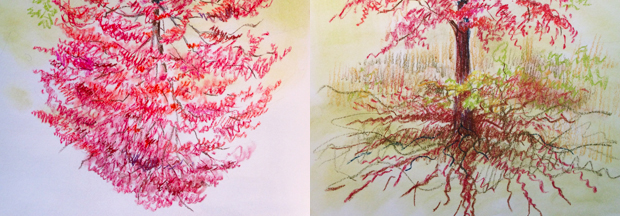
11.24.15_Tree-compositeEconomists and statisticians distinguish between correlation and causality. What if, one day a year, those two were switched? What if they switched once a month, or once a week? Maybe in the minds of the desperate, the distinction is meaningless.

Two Swiss researchers found that when plankton levels in the ocean drop 10%, Somalian pirate activity ticks up a corresponding 10%. With the collapse of the fisheries they’ve relied on for generations, they are driven to find other uses for their boats.

Last year, earthquakes over magnitude 3.0 increased in Oklahoma from an average of less than two per year to 585. Bore holes from fracking chewed their lacy patterns into the earth’s mantle like termites under a house.

Years of drought in a country with poverty and ethnic and religious tensions destabilizes an already stressed situation and tilts the people into civil war, as well as making them easy prey for terrorist organizations. If they’re under authoritarian rule, this is even more likely. Continue reading

Stories are a starting point, not the literal answer

11.7.15_wolf_620w2

In the aftermath of the attacks in Paris, two themes on social media have caught my attention. One goes along the lines that eradication of all evil by violent means is the only possible response to restore safety and normalcy. The other chastises people for identifying with and feeling compassion for Parisians, but ignoring Lebanese, Syrians, and refugees of other ethnicities.

One is dangerously myopic; the other tips too far the other way by insisting that without a worldcentric perspective, your compassion falls woefully short of what is needed right now. I don’t mind having my awareness tweaked. I do object to holier-than-thou snarkiness that judges what I care about. And yet, maybe my discomfort stems from the sudden recognition that I, too, am guilty of looking down on those who don’t share my views or meet my expectations. Continue reading

In search of maps for the territory ahead

1991_Dennis-beach_620w

“For Plato, the allegory of the cave implied a journey beyond the realm of the body and the senses to the realm of immaterial ideas. But its meaning has been hijacked. For materialists, objective reality is not the realm of ideas but mathematicized matter. In the modern version of this allegory, scientists alone can step out of the cave, observe reality as it is, and come back into the cave imparting some of this knowledge to the rest of humanity, confused by rival subjectivities. Only scientists can see reality and truth. The philosopher, and later the scientist, have to free themselves from the tyranny of the social dimension—public life, politics, subjective feelings, popular agitation, in short, from the dark cave—if they want to accede to truth. Back within the cave, the rest of humanity is locked into the realm of multiculturalism, conflict, and politics.” ~ Rupert Sheldrake, Science Set Free

Years ago, I had a fascinating conversation with my nuclear physicist uncle, who spent his career on fusion (the way the sun works), rather than fission (which is how commercial nuclear power is produced). I asked him how he could consider nuclear power to be “clean” energy, when it produces radioactive waste that we hardly know what to do with—other than bury it in sacred mountains and saddle future generations with the problem. He stated that President Carter had ruined the purity of the science by agreeing via treaty never to reprocess spent fuel. The way it was designed originally, spent fuel could be recycled virtually ad infinitum and fed back into reactors, thereby creating a closed loop. (This is my own layman’s interpretation.) He was well and truly offended that politicians would meddle in things they don’t understand. Continue reading

I nominate Pope Francis as the leader of this movement

2009_8.26_Yosemite2_620w

“If we approach nature and the environment without this openness to awe and wonder, if we no longer speak the language of fraternity and beauty in our relationship with the world, our attitude will be that of masters, consumers, ruthless exploiters, unable to set limits on their immediate needs. By contrast, if we feel intimately united with all that exists, then sobriety and care will well up spontaneously. The poverty and austerity of Saint Francis were no mere veneer of asceticism, but something much more radical: a refusal to turn reality into an object simply to be used and controlled.”

I’m going to come right out and say it: I am jazzed about the Pope’s encyclical, “Laudato Si,” or in English, “Praise be.” I’m excited that it’s getting so much attention from all quarters, even the Wall Street Journal and conservative talk-show hosts. I haven’t felt this hopeful about the environmental / social justice movement since “Inconvenient Truth” came out in 2006, or “11th Hour” in 2007, or Van Jones’ brief tenure in the White House in 2009. As Paul Hawken observed in his 2007 book, “Blessed Unrest,” this is the largest movement in the world—and it has no leader.

We do prefer charismatic leaders for our big movements. Hawken helped me to see that this one is just too big to have one figurehead. We won’t have our Gandhi or Martin Luther King, because each of us in this movement is part of the earth’s immune response to an infection, a fever. This movement is an entirely decentralized set of self-organizing systems nested within self-organizing systems the way Nature herself works. And that’s as it should be. Still, I admit wishing now and then for someone to come along. Each time it seemed to happen, we were disappointed. Continue reading

Tragedy of the study of the tragedy of the commons

2014_7.14_620wWith the summer heat comes an uptick of articles about the continuing, perhaps accelerating, breakdown of our social fabric. Whether it’s the arrest of children’s parents for letting them play alone outside or for camping with them, or the absurdity of drinking bottled water, the cracks in what we like to call civilization are growing wider. The public good has gotten so muddied that we are left to argue over semantics: whether a headline was too hyped or a date was cited incorrectly. Or we turn it over to the sociologists to tell us what we’re missing and what it all means.

There’s more to this than the decline of community, as Charles Eisenstein succinctly points out in this essay. He cites our inclination to surrender to authority, our need for control, our obsession with safety, and tendency to self-preservation. He laments the inevitable slide from avoidance of danger and uncertainty to the prison of “consequence-free zones” like video games. All of this is to the detriment of creativity, play, exploration, and risk-taking—everything we so desperately need in order to navigate this threshold time between stories. Continue reading

A simple way to reconnect: experience awe

5.25.15_Cape San Blas_620w

It’s been a busy week of writing deadlines, so I’m taking a shortcut today to share this wonderful article, “Why Do We Experience Awe?” from last Sunday’s New York Times. I love their suggestion, based on years of social psychological research, for how we can feel more connected to each other and the world around us. It’s simple: experience awe on a daily basis.

“ . . . awe is the ultimate “collective” emotion, for it motivates people to do things that enhance the greater good. Through many activities that give us goose bumps — collective rituals, celebration, music and dance, religious gatherings and worship — awe might help shift our focus from our narrow self-interest to the interests of the group to which we belong.”

The world we’ve created for ourselves is so complicated, fast-paced, hyper competitive, and stressful. It’s a profound relief to encounter a couple of scientists who’ve taken the time to test, and prove, this simple hypothesis: Continue reading

Does “Nature” need a new pronoun or do we need a new story?

JFX_upper deck_horiz-crop

This guest post is by Duane Marcus. You can read a bit about him on the “Denizens” page.

I saw a meme on social media that suggested we need a new pronoun for “Nature,” a pronoun other than “it.” This got me thinking about “Nature.” Is nature an entity? Is there a thing we have named “Nature”? When we suggest someone spend some time in “Nature” what do we mean? Most would agree that canoeing through the Everglades or hiking the Appalachian Trail would constitute spending time in “Nature.”  Is an urban park “Nature”? Is the beach in front of a wall of million dollar condos “Nature”? Are fields of corn and soybeans “Nature”? How about a street full of weedy abandoned lots in Detroit?

Nature Deficit Disorder is a hot topic these days. Wikipedia describes it thusly.

Nature deficit disorder refers to a hypothesis by Richard Louv in his 2005 book Last Child in the Woods that human beings, especially children, are spending less time outdoors resulting in a wide range of behavioral problems. So would walking down Madison Avenue help alleviate this? Don’t let your kids do this without adult supervision though because you might get arrested for neglect and child endangerment. Continue reading

Our voices, our power: women’s paradigm-shifting work

Utensils_620w

“For the master’s tools will never dismantle the master’s house. They may allow us to temporarily beat him at his own game, but they will never enable us to bring about genuine change. Racism and homophobia are real conditions of all our lives in this place and time. I urge each one of us here to reach down into that deep place of knowledge inside herself and touch that terror and loathing of any difference that lives here. See whose face it wears. Then the personal as the political can begin to illuminate all our choices.” ~ Audre Lorde, 1984

The resonance of our inner callings with needs and trends in the outer world seems to be gathering momentum lately. In this time between stories, I am being urged, by both interior and exterior promptings, to value my unique voice and speak up more. The signs I get range from encouragement like Audre Lorde’s 1984 speech, to learning from Priscilla Ward’s eye-opening essay about her experience as a black woman, to the fierce witnessing of Nell Bernstein in this interview about her book on juvenile incarceration, Burning Down the House.

At the time of Audre Lorde’s speech, I was just graduating from college, looking to work a year in a firm before grad school. Very much playing the game by the rules. Ronald Reagan as President was busy dismantling the social safety net so carefully woven over the last decades. The Soviet Bloc countries boycotted the summer Olympics in Los Angeles. Feminism had been around for a couple of decades. Though I did not identify as a feminist, I was entering a traditionally male profession, slipping noiselessly if unconsciously through the access hard-won by my sisters before me. Continue reading

Hiding when out of sync is a generous act of love

1991_Dennis-beach_620w

When I am unconsciously following the rules and stories installed in me during childhood, I sometimes worry that I am doing my life wrong. For instance, I was never taught that there are times when it’s perfectly justified to follow my instincts, to do or be what my heart urges. In fact, a life well-lived is a life entirely guided by the heart’s urgings. Still, I can feel a bit guilty when I need to withdraw from the world’s demands on me.

For so long, I believed that my retreat from conflict, difficulty, boredom, hostility, shame or blame was a bad thing that I inflicted, selfishly, on my close relationships. In this beautiful essay on hiding, the poet David Whyte sees it as a form of self-preservation, a drawing inward to prepare for transformation, and a necessary storing up of vital energy for growth.

“Hiding is one of the brilliant and virtuoso practices of almost every part of the natural world. . .”

Continue reading

This threshold of despair, fear, anger, and pain could be an opening to a new conversation

Faces

“I believe that all suffering is caused by ignorance. People inflict pain on others in the selfish pursuit of their happiness or satisfaction. Yet true happiness comes from a sense of brotherhood and sisterhood. We need to cultivate a universal responsibility for one another and the planet we share.” ~ Dalai Lama

I am breaking tradition and using a photograph to start this post because it is such a beautiful, heartbreaking image of the pain and fear that keep us separated. There are only a few inches between the faces of these two men, yet it is a wholly unbridgeable gulf. This is a scene from the streets of Baltimore yesterday, a place of constant tension, trauma and hatred, from which those of us living our quiet, privileged lives in other neighborhoods are usually insulated.

Truth be told, I am still insulated, tracking these events, unfolding mere miles away, via social and traditional media. It’s been fascinating to see how people react when our old cultural stories are so blatantly exposed and people act out and behave in ways that shock us. Many are expressing righteous outrage, as when our mayor called the instigators “thugs,” and questioned their intelligence with this comment: “It is idiotic to think that by destroying your city you’re going to make life better for anybody.” Continue reading