Love is courage in action

1.22.15_snow-berries_620w

Where there is hatred, let me sow love.

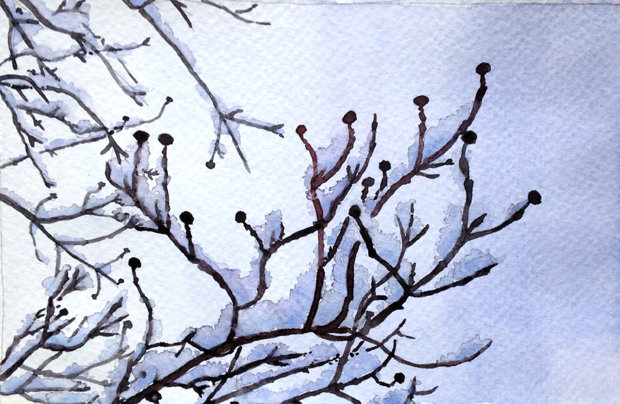
Given that outer is a reflection of inner, love begins within. I sow love by bringing its warmth and compassion into the cold, dark, unloved places deep inside me. I wonder it’s this region that is moved to tears when touched by a beautiful sunrise or sunset. Or the beauty of the world in general, which has much to teach me about love. Red berries touched by snow, whitecaps on water, a young boy singing the high soprano notes opening “Once in Royal David’s City.”

The film “Still Alice” is a lovely exploration of this verse. While she, and her family, hated what was happening to her well-honed intellectual mind, they made the choice to seek solace in the love that bound them together. That love, and the attendant grief of loss, illuminated unique aspects of each of them. The youngest daughter, Lydia, had the fiercest courage to face her emotions, and so she let her love turn to curiosity. She asked her mother what she was experiencing, giving her the precious gift of being witnessed. To stand in helplessness with that much power requires tremendous love and awareness. Continue reading →

Cultivating our ability to balance opposites and heal separation

2014_7.1_620w

This wonderful five-minute talk by Llewellyn Vaughn-Lee about women and the mystery of creation appeals to the great potential of the sacred feminine to help shift our cultural stories. When you think about it, how miraculous it is that women have this ability to bring a new person into the world, to give a soul the experience of this physical plane. Spirit and matter are literally united within a woman’s body.

Throughout most of human history, women, therefore, were the guardians of the spiritual life of the people. Their connection to the earth’s cycles and seasons, as well as its great Creative power, made this connection natural and enduring. Anything we can do to align with the cyclical and the non-linear, the intuitive and the more-than-rational, will feed into this connection. Continue reading →

Allowing emerging new stories to have their way with us


2000_7.20_Uluru_620w

“We need a new story” seems to be coming out of more and more people’s mouths these days. From Thomas Berry to Joanna Macy and Charles Eisenstein, to David Korten and Duane Elgin. Each of these deep thinkers and actors has their own unique spin on the diagnosis, as well as ideas for what we might do to begin changing the story. One of my personal favorite pieces of writing about this is “Dark Ecology,” by Paul Kingsnorth, the co-founder along with Dougald Hine of the Dark Mountain Project. At the end of that essay, he cautions:

“If you think you can magic us out of the progress trap with new ideas or new technologies, you are wasting your time. If you think that the usual “campaigning” behavior is going to work today where it didn’t work yesterday, you will be wasting your time. If you think the machine can be reformed, tamed, or defanged, you will be wasting your time. If you draw up a great big plan for a better world based on science and rational argument, you will be wasting your time. If you try to live in the past, you will be wasting your time. If you romanticize hunting and gathering or send bombs to computer store owners, you will be wasting your time.”

Continue reading →

We have a lot to learn from nature’s design intelligence, even if throwing a hammer in first doesn’t help

Hunters Field_620w

Yesterday, I mentioned David Korten’s work on new economic systems, which he calls “living economies.” This strikes me as a beautiful interim step away from our unquestioned disconnection from nature and elevation of reason over intuition, towards a more humble, conscious, and connected relationship with the living earth. We’re talking here about “biomimicry,” which I first discovered from Janine Benyus, a science writer who published a book by the same name in 1997.

Biomimicry has three basic principles. 1) Nature as model. Study, learn, and imitate how nature works, rather than how objects in nature look. 2) Nature as measure. Use an ecological standard to judge the rightness of our innovations. Nature has a 3.8 billion year head start on us and has learned what works, what is appropriate and what lasts. 3) Nature as mentor. Approach nature not from a perspective of what we can extract, but of what we can learn. Continue reading →

Living with the messy realities of both/and

2014_7.3_620w

“It was the best of times, it was the worst of times, it was the age of wisdom, it was the age of foolishness, it was the epoch of belief, it was the epoch of incredulity, it was the season of Light, it was the season of Darkness, it was the spring of hope, it was the winter of despair, we had everything before us, we had nothing before us, we were all going direct to Heaven, we were all going direct the other way – in short, the period was so far like the present period, that some of its noisiest authorities insisted on its being received, for good or for evil, in the superlative degree of comparison only.” ~ Charles Dickens

This opening to A Tale of Two Cities is a perfect encapsulation of how reality feels to me these days, and I am aware that many of us are living with the strangeness of both/and. I’ve had several conversations lately to puzzle over the apparent stalling of green building in my area, even while trend graphs put out by the U.S. Green Building Council look rosy as ever. I wouldn’t go so far as to lament that it was a fad that’s now fizzling, but I am curious about what feels like a slowdown, if not a general lack of interest, as compared with most of the 2000’s. Here’s a story that is not atypical. Continue reading →

It’s all sacred, so give up control and enjoy the ride

2014_7.14_620w

“There are no non-sacred places. There are only sacred places and desecrated places.” ~ Wendell Berry

Towards the end of Maureen Murdock’s book, “The Heroine’s Journey,” she brings up Matthew Fox’s observation that the sin behind all sin is dualism, that force behind all separations: from the self, from other people, from nature, from the sacred. When blinded by dualism, we see everything and everyone outside of ourselves as “other,” as object, a thing we can control, manipulate, dominate, or own.

It seems to me that the way back from this separation is to see everything in terms of “both/and,” a grand dance of opposites, a constantly shifting, dynamic paradox that we navigate with humility and imagination. In a given situation, when I jump to a particular conclusion that causes or contributes to conflict, I would do well to take a breather and imagine the opposite being just as true. Continue reading →

A daily practice to experience and live in abundance

2014_8.28_620w-2

I’ve been researching the watermen of the Chesapeake Bay, particularly the residents of Smith Island, one of only two inhabited islands in the Bay. These men toil long hours — 3:30 a.m. to 3:00 p.m. at the height of summer — doing backbreaking work for what we in cities might call a subsistence living. They work six days a week and attend church meetings and services on Sunday. Their only time off is the month of April, after the oyster season and before the crabs return. That’s the month when they get to sleep in till dawn, overhaul their boats and swap stories at the general store.

People like this, who work the water or the land, have profound and hard-won knowledge of the cycles of the seasons, of weather, of periods of abundance and of scarcity. They’ve been around long enough to recognize patterns and trends, and also to hold such insights lightly, because nature always surprises you. One thing is certain: these people know what it feels like to do a good day’s work. Continue reading →

Could psilocybin be a shortcut to new stories?

2.15.15_Winter woods_620w1

I’m by turns curious about and frustrated by the way modern culture insists on scientific proof before an experience or phenomenon can be considered “real.” And while absence of proof is hardly proof of absence, there is considerable resistance to believing the unmeasured. This instrumentalism is one of our civilization’s dominant stories, part of the operating system behind our rationality-soaked worship of science.

And so we are driven to shine light on the unseen, to reduce mystery to chemistry, biology or psychology. Barbara Ehrenreich, author of the 2014 book, Living With a Wild God, is a good champion of the idea that faith is intellectually lazy, and prefers the question, “Why believe when you can know?” And yet, her book and John Geiger’s The Third Man Factor both admit that certain numinous and mystical experiences elude fully rational explanations. Michael Pollan’s recent piece in The New Yorker, “The Trip Treatment,” is another intriguing foray into the science of human spirituality. Continue reading →

In the terrain between stories, trust that maps do exist

2.15.15_Two pines_620w

I am a framework junkie. I love the satisfaction of seeing a complex process or perspective distilled into diagrams, able to be grasped at a glance. Sure, some detail is omitted, but the best frameworks capture essence and convey key information to guide understanding and/or action. A good map is one example, or an infographic about, say, the growth in income disparity over the last decade.

I keep hearing it said that, in this time between stories, we’re wandering in unknown territory without a map. And that is how it feels much of the time. Yet, there are workable maps and frameworks that can inform both personal and cultural choices, if not direction. I’m thinking particularly of various takes on developmental psychology, like Spiral Dynamics, or Rudolph Steiner’s seven-year cycles, or Bill Plotkin’s map of the human psyche. I find it comforting to have a picture of where I’ve been and to see possible routes on my continuing quest for wholeness and belonging. Continue reading →

Holding complexity in community

1.25.15_Dogwood-snow_620w

This guest post is by Lindsay McLaughlin. You can read a bit about her on the “Denizens” page. 

It is cold. The mud on the path to the Meditation Shelter has frozen up in small bubbles and lumps. It crunches and crackles underfoot. The tree trunks and tangled branches are etched crisply against a pale sky, the high contour of the ridge clearly visible through the dry air. There are long pauses in the conversations of the forest creatures: a woodpecker’s thunk- thunk, silence, a blackbird’s caw, silence. The water in Deer Spring creek has stopped in icy patterns against the stones. I am reminded of the phrase we use when calling on the directions at the beginning of Restorying retreats: “Let us turn to the North, place of frozen stillness and quiet waiting, home of wolf and the season of winter…” Continue reading →