Owning the story: the seduction of illusion and the power of dreams

JFX_greenbridge_horiz_620w

I am fascinated by the power of story to sell or derail an idea. Sometimes I think of storytelling, that ancient and most connecting of arts, like The Force in “Star Wars.” Story can be used for good or for evil. Even with good intentions, it tends to be used as mindless entertainment, or for selling products or launching a mission-driven campaign. A fine example of the Dark Side of Story is found in the documentary, “Merchants of Doubt,” which jumps off from the 2010 book of the same name by Naomi Oreskes and Erik Conway.

These are the players who sow doubt in the public’s mind about the credibility or consensus of the scientific community around a specific topic. They do this to stall or scuttle environmental and health regulations. They started with tobacco, then moved on to toxic chemicals like flame retardants, and now are using the same proven techniques on climate change. The film employs imagery in creative ways. A sleight-of-hand magician demonstrates misdirection and murky banks of hidden files signify the “playbook” of confusion and lies. Archival footage of experts is intercut with contemporary interviews of the same people, to dramatize the passage of decades, the sweep of lives dedicated either to scientific study or to its obfuscation. Continue reading

At play in the field between imagination, fantasy, and reality

2010_8.12_620w

“Logic only gives man what he needs… Magic gives him what he wants.” ~ Tom Robbins

When you steep a while in the world of Story, everything starts to seem a little less “real.” The line between fact and fiction becomes blurred. Even when I work with clients, their businesses and buildings can feel a bit staged, like a game we are all playing. I am aware that few—if any—of them see it that way, so I’m careful about what I say. The truth is, though, that I’ve always had a rather loose hold on reality, feeling more at home in a world of fantasy and imagination than in the hyper-competitive, fast-paced, dog-eat-dog world out there.

This may account for my proficiency at writing proposals and designing buildings. I can cast forward and imagine the shining whole, complete and beautiful. It’s the in-between stages that are more of a slog, with their constraints of budgets and code officials and physics. Slogging is what I was taught—what we were all taught—about turning ideas into reality. In recent years, I’ve been encountering and learning about other ways to do it, ways that reach me on an intuitive level but that mostly elude me on a practical level. These are ancient ways of relating to the world and tapping our human faculties that we moderns can learn even today. Continue reading

Truth, beauty, wild yeast and courting revelation

Omega lake_97_640w

When you are tuned in via a creative process that works for you, surprising things come through. Writing is one medium that does that for me. I start noodling some ideas around—often, two or three seemingly unrelated ones that have caught my attention. It helps to ask questions like What is this really about? and What am I trying to say? In the course of the writing, insight sneaks in.

I want to say revelation, but keep choosing the word insight for its modesty, its unwillingness to make demands. Maybe it’s like when bakers or brewers rely on wild yeast, rather than controlled addition of packaged yeast. I picture wild yeast as dust motes floating invisibly on currents of afternoon air warmed by low streaks of sunlight. Where does wild yeast even come from? Can bakers and brewers count on it being there in the air, waiting to dive into their dough or mash, to mate with their flour, rye or barley? Is that the appeal: the risk, the lack of control, the mystery? Continue reading

Alone time practices connect to joy

7.19.15_Ashland_620w

Self-care is an evolving discipline for me. I was labeled selfish and moody as a child, often sent to my room for being too emotionally intense. It may have been a practical strategy for a mother coping with four young children, but I didn’t understand that at the time. To this day, my alone time feels subversive. The deep core of Puritan work ethic and dedication to service in our cultural story can be misappropriated to guilt people, especially women, into caring only for others.

And yet, most spiritual traditions teach the importance of attending to oneself as an essential part of a life well lived. Modern teachers sometimes invoke the airplane oxygen mask as metaphor: you must secure your own mask before helping another with theirs. There’s also the cup of tea metaphor. Only once you’ve filled your cup to overflowing will you be able to give someone the tea that has spilled into the saucer. Continue reading

The Muse is my client: thoughts on writing and architecture

Labrouste_composite

“Acknowledging that the first draft is the equivalent of a sculptor going down to the quarry to buy a big slab of marble, or a mason buying a skid of bricks and 100 pounds of mortar is a very difficult thing to do.” ~ Shawn Coyne

It takes longer to write a novel than to design and build a good-sized building. Something like a church might take three or four years, start to finish. Apartments or a university classroom building maybe two-and-a-half. A house is more like a novella in size, but can take just as long, depending on complexity and how decisive or demanding the client is. A kitchen addition is a short story. It can be done in eight or ten months, give or take.

What is the use of writing a book? A building shelters thousands of people for decades, if not generations. It touches lives. It affects people. Even a bad building—say, a Target or a WalMart—serves a useful purpose. The literary equivalent might be a Nicholas Sparks novel, which is maybe why you see racks of them at stores like that. A few great buildings rise above, delighting us with their artfulness and lasting for hundreds of years. These are lovingly restored from time to time, and contain deep cultural, social and political histories. Continue reading

Creative play is key to resilience and possibility

6.14.15_Bay bridge2_620w

“The creative process is a process of surrender, not control.” ~ Julia Cameron

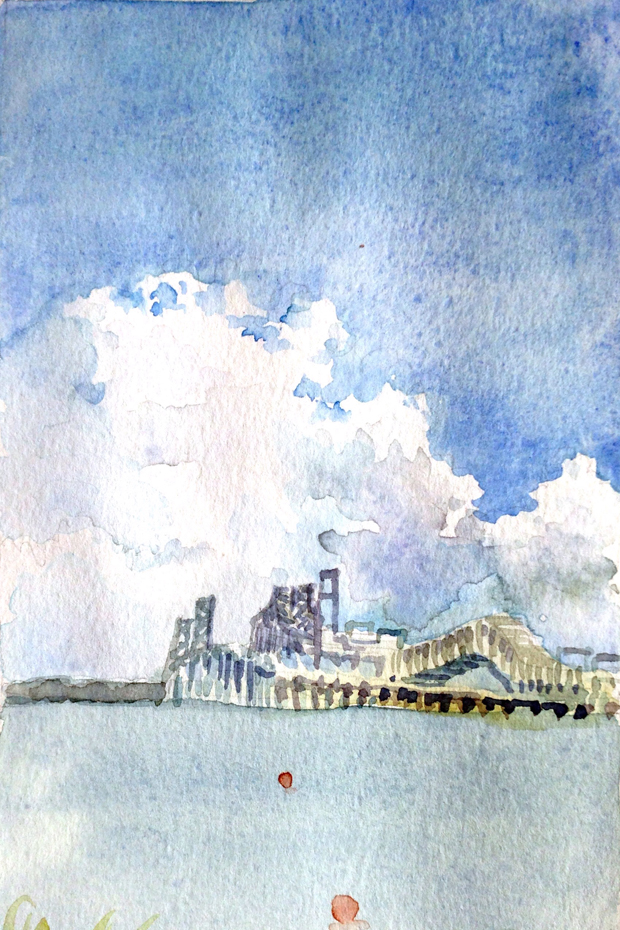
I’ve been following my heart more and paying attention to a) what it guides me to do, b) how it feels to do it, and c) what the aftereffects are. Yesterday I was reminded that I have more resources in potentially frustrating situations when I’ve been creative at some point in the day. Yesterday morning, inspired by Nina Katchadourian’s “Sorted Books Series,” I played with arranging random but interestingly-titled books in stacks to form poetic phrases. Later, I spent maybe twenty minutes doing a quick watercolor of clouds over the Chesapeake Bay Bridge while at the after party for the annual Bay Swim.

That evening, when faced with a cranky, most unpleasant teenager, I seemed to have endless patience with him. Instead of the usual reactionary “who do you think you are” inner voice goading me to say things I’ll regret, I kept trying different tactics to reach him and bring him back to his usual sunny self. I stayed calm and nimble, creative instead of triggered. What’s behind this magic? My first thought is that creative play inoculates me. It puts me in a good mood, so I can face challenges with resilience. And, while that’s true to a degree, there’s something deeper at work here. Continue reading

Hiding when out of sync is a generous act of love

1991_Dennis-beach_620w

When I am unconsciously following the rules and stories installed in me during childhood, I sometimes worry that I am doing my life wrong. For instance, I was never taught that there are times when it’s perfectly justified to follow my instincts, to do or be what my heart urges. In fact, a life well-lived is a life entirely guided by the heart’s urgings. Still, I can feel a bit guilty when I need to withdraw from the world’s demands on me.

For so long, I believed that my retreat from conflict, difficulty, boredom, hostility, shame or blame was a bad thing that I inflicted, selfishly, on my close relationships. In this beautiful essay on hiding, the poet David Whyte sees it as a form of self-preservation, a drawing inward to prepare for transformation, and a necessary storing up of vital energy for growth.

“Hiding is one of the brilliant and virtuoso practices of almost every part of the natural world. . .”

Continue reading

Mirroring the courage to speak up and tell new stories

1998_7.12

I’ve long been fascinated by the ways that my inner and outer worlds mirror each other. Even way back in college, I somehow knew that annoying people are reflecting something in me that I don’t like. I’m devoted to dream work and my morning journaling for the insights and clarity that often come, and to writing in this blog for the same reason. I tend to regard this reciprocal conversation as a way to diagnose what’s wrong from the inside out, more so than to notice and appreciate what’s right outside, and how it reflects goodness on the inside.

Yet it does work both ways, and it’s going on all the time. When someone I respect questions or refuses to encourage my latest grand scheme, that is showing me the degree to which I am not on board with it myself. But it’s also true that if I look around at my comfortable home, good health, lovely neighbors, engaging work, responsible husband, and yummy food in the fridge—all that is reflecting an inner world that is safe, healthy, and full of good companionship, worthiness, love, creativity, intelligence, security, and nourishment. Continue reading

While we are making plans, the Earth is making us

2003_flowers_620w

All I want is to sing to you
The song that no one has heard
~ Krishna Das, from Heart as Wide as the World

We seem to be fond of comparing ourselves to animals, or, as native people tend to call them, the four-leggeds. Our post-Enlightenment minds play this game by finding ourselves to be superior to those “Others.” One story we like is that we are the only conscious beings on the planet, which is rapidly being debunked even by modern science. I did recently think of this difference, though: we make plans. We take on long-term projects that last beyond seasons, that may take five or ten years to complete. And sometimes our projects fail.

Plants and animals are seasonal, and their physical aims much simpler: survival and reproduction. They don’t seem to have the ambition to change their surroundings or invent things or look at distant galaxies, let alone travel to them. They don’t make musical instruments or write symphonies or Shakespearean plays. And yet they are part of a vast dance, a swirling ongoing Creation that is impossible to comprehend in its entirety. While we make plans, the Earth makes us. Continue reading

Improvisation unlocks the magic of spontaneity and connection

2006_Maine_620w

All told, we’ve collaborated to offer eleven Restorying retreats over the last two years, with more in the planning stages. They’ve come to have a dynamic balance between structure and improvisation. We are learning as leaders to be present and notice the field, to give ourselves over to what wants to happen next, what the earth is dreaming for us. Within a framework of ritual and ceremony, poetry and mythic time and space, we enter the door that leads to the realm of heart and soul and mystery.

Themes, questions, and insights begin to weave into and through the assembled group from the first gathering. We are getting better at tuning into that and inviting participants to join in the fun of giving ourselves over to what Mystery wants to do with us. It reminds me of what Malcolm Gladwell had to say about improvisation in his book, Blink. Using basketball as an example, he wrote that in practice, the players drill patterns and set-ups relentlessly, and then every game is totally improvisational. The patterns are strung together in completely new ways in every game, every moment. I can guess from the way my son talks about soccer that it’s much the same. Continue reading