About julie@goforchange.com

Julie Gabrielli is fascinated by the power of story to heal, reconnect, and create our world. She has logged years of dedicated studentship and mentorship through work as an architect. She also uses writing, painting and film to explore the threshold between damaging cultural stories and emerging new narratives. Her Restorying retreats offer a place to listen for and experience our inherent belonging and connectedness. Parenting used to be her most humbling activity until she started writing a novel.

The Muse is my client: thoughts on writing and architecture

Labrouste_composite

“Acknowledging that the first draft is the equivalent of a sculptor going down to the quarry to buy a big slab of marble, or a mason buying a skid of bricks and 100 pounds of mortar is a very difficult thing to do.” ~ Shawn Coyne

It takes longer to write a novel than to design and build a good-sized building. Something like a church might take three or four years, start to finish. Apartments or a university classroom building maybe two-and-a-half. A house is more like a novella in size, but can take just as long, depending on complexity and how decisive or demanding the client is. A kitchen addition is a short story. It can be done in eight or ten months, give or take.

What is the use of writing a book? A building shelters thousands of people for decades, if not generations. It touches lives. It affects people. Even a bad building—say, a Target or a WalMart—serves a useful purpose. The literary equivalent might be a Nicholas Sparks novel, which is maybe why you see racks of them at stores like that. A few great buildings rise above, delighting us with their artfulness and lasting for hundreds of years. These are lovingly restored from time to time, and contain deep cultural, social and political histories. Continue reading
Rolling Bubble

On the way to the neighborhood
Fourth of July parade,
I saw a soap bubble
the size of a small cantaloupe
rolling down the faded center line
of the rain-slick street.
A perfect rainbow orb, running free, until
I pierced it with my glance.
Playing that moment from memory,
I watch the bubble float from origins unknown
over a tall, newly-clipped hedge,
descend over the eastbound lane
and land with intention on the painted yellow line.
My memory also reveals
that by the time I noticed what was happening—
a good-sized soap bubble
rolling down the middle of a wet street—
in that very instant,
it burst.
I asked my husband,
Did you see that bubble rolling down the street?
He had just missed it.

In search of maps for the territory ahead

1991_Dennis-beach_620w

“For Plato, the allegory of the cave implied a journey beyond the realm of the body and the senses to the realm of immaterial ideas. But its meaning has been hijacked. For materialists, objective reality is not the realm of ideas but mathematicized matter. In the modern version of this allegory, scientists alone can step out of the cave, observe reality as it is, and come back into the cave imparting some of this knowledge to the rest of humanity, confused by rival subjectivities. Only scientists can see reality and truth. The philosopher, and later the scientist, have to free themselves from the tyranny of the social dimension—public life, politics, subjective feelings, popular agitation, in short, from the dark cave—if they want to accede to truth. Back within the cave, the rest of humanity is locked into the realm of multiculturalism, conflict, and politics.” ~ Rupert Sheldrake, Science Set Free

Years ago, I had a fascinating conversation with my nuclear physicist uncle, who spent his career on fusion (the way the sun works), rather than fission (which is how commercial nuclear power is produced). I asked him how he could consider nuclear power to be “clean” energy, when it produces radioactive waste that we hardly know what to do with—other than bury it in sacred mountains and saddle future generations with the problem. He stated that President Carter had ruined the purity of the science by agreeing via treaty never to reprocess spent fuel. The way it was designed originally, spent fuel could be recycled virtually ad infinitum and fed back into reactors, thereby creating a closed loop. (This is my own layman’s interpretation.) He was well and truly offended that politicians would meddle in things they don’t understand. Continue reading

A case for seeing human affairs through the eyes of grace

1998_7.19_620w

“I wish grace and healing were more abracadabra kind of things. Also, that delicate silver bells would ring to announce grace’s arrival. But no, it’s clog and slog and scootch, on the floor, in the silence, in the dark.” ~ Anne Lamott, from Grace, Eventually

Grace is a word you don’t hear much in secular discourse. Last week, President Obama’s eulogy for Rev. Clementa Pinckney was both about grace and full of grace itself. It awakened a memory of a conversation about grace with my father when I was in High School. He was one of those traditional dads who worked and did dad things, so I didn’t have a lot of interactions with him. This conversation about grace was a rarity. Turns out, he couldn’t quite put his finger on it, either. I think he spoke of God’s presence or friendship, and we both enjoyed wondering about it together. That in itself was a moment of grace, a precious heart connection to each other and to something bigger than us.

Human affairs are full of flaws, opposition and contradictions. There never seems to be that one right solution that we can all agree on. And so we wrangle. In interactions with friends about the President’s recent successes, they were quick to point out his many failures and betrayals. It’s true he compromised on health care reform, and I can’t say I understand the appeal the Trans Pacific Partnership, which seems to me like a nightmare for workers and the environment. And let’s not forget, these friends say, about the drone strikes and the “Surge.” I get it, I do. And yet, there’s something we are missing when we argue like this. It’s too easy to find these imperfections. Continue reading

I nominate Pope Francis as the leader of this movement

2009_8.26_Yosemite2_620w

“If we approach nature and the environment without this openness to awe and wonder, if we no longer speak the language of fraternity and beauty in our relationship with the world, our attitude will be that of masters, consumers, ruthless exploiters, unable to set limits on their immediate needs. By contrast, if we feel intimately united with all that exists, then sobriety and care will well up spontaneously. The poverty and austerity of Saint Francis were no mere veneer of asceticism, but something much more radical: a refusal to turn reality into an object simply to be used and controlled.”

I’m going to come right out and say it: I am jazzed about the Pope’s encyclical, “Laudato Si,” or in English, “Praise be.” I’m excited that it’s getting so much attention from all quarters, even the Wall Street Journal and conservative talk-show hosts. I haven’t felt this hopeful about the environmental / social justice movement since “Inconvenient Truth” came out in 2006, or “11th Hour” in 2007, or Van Jones’ brief tenure in the White House in 2009. As Paul Hawken observed in his 2007 book, “Blessed Unrest,” this is the largest movement in the world—and it has no leader.

We do prefer charismatic leaders for our big movements. Hawken helped me to see that this one is just too big to have one figurehead. We won’t have our Gandhi or Martin Luther King, because each of us in this movement is part of the earth’s immune response to an infection, a fever. This movement is an entirely decentralized set of self-organizing systems nested within self-organizing systems the way Nature herself works. And that’s as it should be. Still, I admit wishing now and then for someone to come along. Each time it seemed to happen, we were disappointed. Continue reading

Tragedy of the study of the tragedy of the commons

2014_7.14_620wWith the summer heat comes an uptick of articles about the continuing, perhaps accelerating, breakdown of our social fabric. Whether it’s the arrest of children’s parents for letting them play alone outside or for camping with them, or the absurdity of drinking bottled water, the cracks in what we like to call civilization are growing wider. The public good has gotten so muddied that we are left to argue over semantics: whether a headline was too hyped or a date was cited incorrectly. Or we turn it over to the sociologists to tell us what we’re missing and what it all means.

There’s more to this than the decline of community, as Charles Eisenstein succinctly points out in this essay. He cites our inclination to surrender to authority, our need for control, our obsession with safety, and tendency to self-preservation. He laments the inevitable slide from avoidance of danger and uncertainty to the prison of “consequence-free zones” like video games. All of this is to the detriment of creativity, play, exploration, and risk-taking—everything we so desperately need in order to navigate this threshold time between stories. Continue reading

Confronting the “other” is an invitation to spiritual growth

2014_7.13_2_620w

“When you think everything is someone else’s fault, you will suffer a lot. When you realize that everything springs only from yourself, you will learn both peace and joy.” ~ Dalai Lama

I’ve heard the term “spiritual growth” so much that I at some point I stopped wondering what it means. Wise teachers tell us that spiritual growth stalls when we attack others as evil instead of facing our own failures. With honest self-appraisal ideally comes the humility to recognize our need to grow, literally to expand our capacity to learn from those with whom we disagree. In that sense, then, spiritual growth is a process of making room for opposites inside of us.

This requires a stretching of consciousness, a way of confronting our self-imposed boundaries, our cultural story of separateness. The story is so deeply ingrained, though, that it taxes the imagination to see good and evil as part of one whole, rather than an opposition that begs to be resolved through force and war. Continue reading

Creative play is key to resilience and possibility

6.14.15_Bay bridge2_620w

“The creative process is a process of surrender, not control.” ~ Julia Cameron

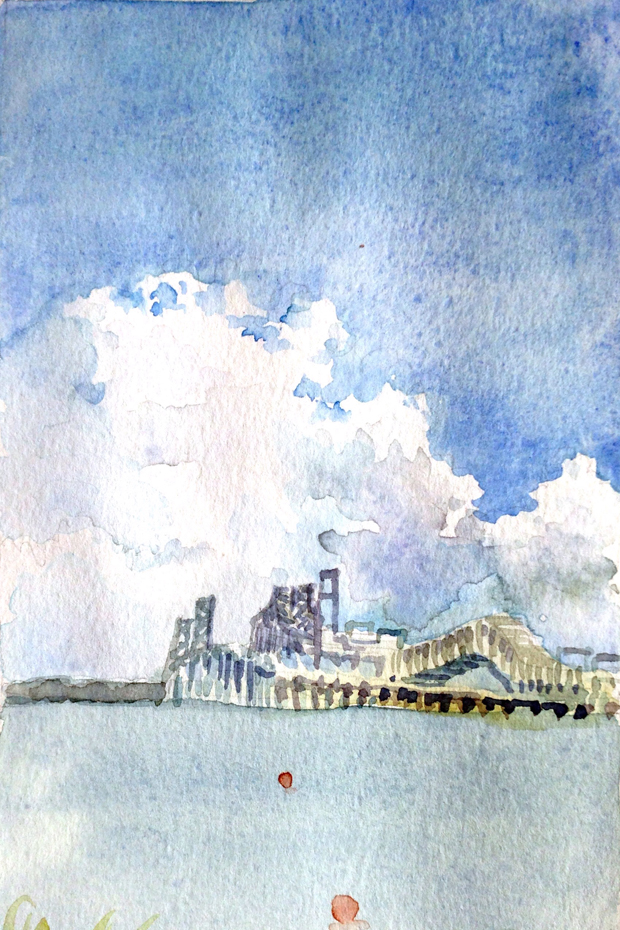
I’ve been following my heart more and paying attention to a) what it guides me to do, b) how it feels to do it, and c) what the aftereffects are. Yesterday I was reminded that I have more resources in potentially frustrating situations when I’ve been creative at some point in the day. Yesterday morning, inspired by Nina Katchadourian’s “Sorted Books Series,” I played with arranging random but interestingly-titled books in stacks to form poetic phrases. Later, I spent maybe twenty minutes doing a quick watercolor of clouds over the Chesapeake Bay Bridge while at the after party for the annual Bay Swim.

That evening, when faced with a cranky, most unpleasant teenager, I seemed to have endless patience with him. Instead of the usual reactionary “who do you think you are” inner voice goading me to say things I’ll regret, I kept trying different tactics to reach him and bring him back to his usual sunny self. I stayed calm and nimble, creative instead of triggered. What’s behind this magic? My first thought is that creative play inoculates me. It puts me in a good mood, so I can face challenges with resilience. And, while that’s true to a degree, there’s something deeper at work here. Continue reading

We can’t see the shadow but we know it’s there

2009_8.26_Yosemite2_620w-3

“When you turn to the sun, all shadows fall behind you.” ~ African proverb

I usually visualize the shadow as a dark cavern deep inside me, the kind you have to swim to the bottom of a lake to find, and that leads almost to the center of the earth. I like this proverb because it provides another image. The shadow follows us wherever we go. Maybe it can even take on a life of its own. In the second book of the children’s series, Peter and the Starcatchers, the evil Lord Ombra steals people’s shadows to possess them, read their thoughts and enslave them. The shadow is imagined as a kind of repository for an individual’s essence, but the fact remains that it is ever and always behind me. I never can turn around and face it squarely.

In the Tantric tradition, the back body is aligned with the universal, the front with the individual. This is a wonderful way to imagine wholeness: it’s in our body that we integrate our uniqueness with the wider world. The front is our place of effort, of being who we are in the world. The back is the unknown, the unseen, and yet it is always there, ready to support and help us when needed. This fits nicely with the classic teaching that the shadow is part of our childhood survival toolkit. Continue reading

Dragons and princesses: the magic and power of the shadow

2000_7.9_Whitsunday sunset_crop

I’m feeling resistance to delving further into this topic of the shadow. It demands honesty and strips off masks. With nothing to hide behind, I tell myself it’s too hard or it’s all been said before. What can I possibly add to the conversation? And yet this resistance itself is a perfect invitation, a dare to keep going. Shadow is not only a repository of shame and evil. It’s a treasure house of insight for those with the courage to look.

As slippery and tricky as the shadow is to pin down, we encounter it daily just by living life. Whatever shows up to block my way, to challenge and frighten me—that’s showing me my shadow. When a person or situation brings up strong emotion—especially aversion, fear, anger, or shame—that’s revealing something deeply buried. Either I know about it and thought it was safely under lock and key, or it’s been so long ignored, denied, or unacknowledged, I’m taken by surprise. Being blindsided happens less often now, but it does happen. Continue reading